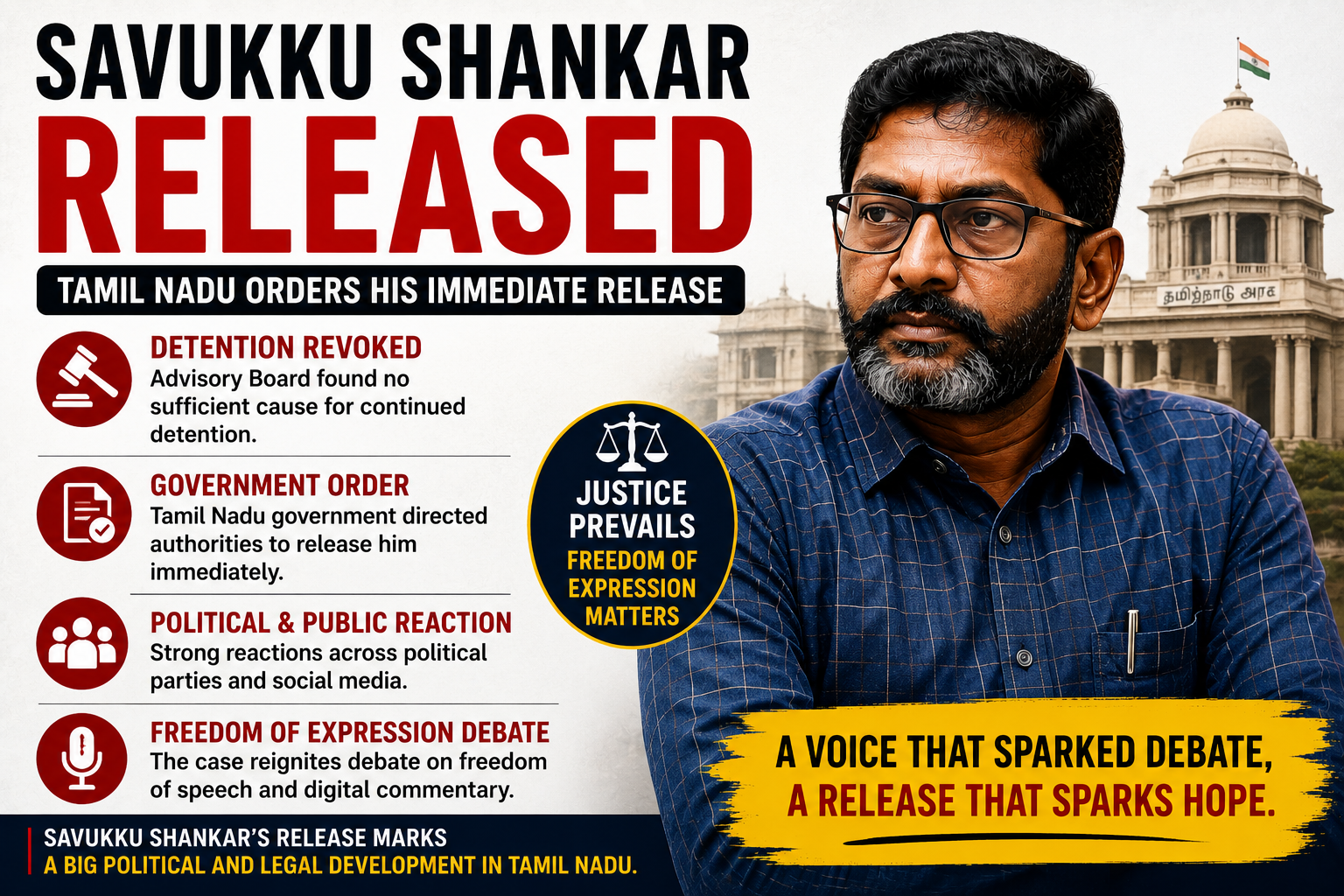
Tamil Nadu politics witnessed another major controversy and public debate following the release of political commentator and YouTuber Savukku Shankar after the revocation of his detention under the Goondas Act. The development has attracted widespread attention across political circles, media platforms, legal communities, and social media discussions throughout the state.
Savukku Shankar has remained one of the most controversial political voices in Tamil Nadu over the last few years. Known for his outspoken criticism of political leaders, government systems, police departments, and administrative structures, he built a strong online following through his political commentary and digital media presence.
His detention under the Goondas Act created significant political reactions and public discussions regarding freedom of speech, preventive detention laws, media influence, and political criticism in modern Tamil Nadu politics.
The recent decision to revoke his detention and order his release has once again brought him into the center of Tamil Nadu’s political conversation.
Who Is Savukku Shankar?
Savukku Shankar is a political commentator, YouTuber, and former government employee who became widely known for his strong political opinions and investigative-style commentary on Tamil Nadu politics.
He gained popularity through digital platforms where he regularly discussed:
- Tamil Nadu political developments
- Government administration
- Corruption allegations
- Law enforcement controversies
- Election politics
- Bureaucratic issues
- Media narratives
His direct communication style and controversial statements helped him build a large online audience, particularly among politically active viewers.
Over time, Savukku Shankar became a recognizable political voice in Tamil digital media. Supporters often described him as fearless and outspoken, while critics accused him of crossing legal and ethical boundaries in public commentary.
The Goondas Act Detention
Savukku Shankar’s detention under the Goondas Act became one of the most discussed legal and political developments in Tamil Nadu.
The Goondas Act is a preventive detention law used in Tamil Nadu to detain individuals considered threats to public order. The law allows authorities to detain persons without immediate trial under certain circumstances.
According to reports, multiple legal complaints and cases were filed against Savukku Shankar before his detention. Authorities claimed that his activities and statements justified preventive action under the law.
However, the detention immediately triggered political and legal debates across the state.
Several activists, opposition voices, media observers, and civil rights supporters questioned whether preventive detention laws should be used against political commentators and digital media personalities.
The issue quickly evolved beyond a single legal case and became part of a larger debate surrounding freedom of expression and political criticism in India’s digital era.
Advisory Board Review and Release
The major turning point came after the Advisory Board reviewed the detention order.
Reports stated that the Board found insufficient grounds for continuing the preventive detention. Following the review, the Tamil Nadu government revoked the detention order and directed authorities to release Savukku Shankar immediately unless he was required in connection with any other case.
This decision generated strong reactions from both supporters and critics.
For supporters, the release represented a victory for democratic expression and legal accountability. For critics, the controversy continued to raise concerns about responsible public commentary and political influence through digital platforms.
Regardless of political opinions, the case became one of the most widely discussed political developments in Tamil Nadu.
Political Reactions Across Tamil Nadu
The release of Savukku Shankar triggered sharp reactions from political parties, media analysts, and public figures.
Supporters’ Perspective
Supporters argued that:
- Political criticism should not automatically lead to preventive detention.
- Digital commentators should have the right to question governments and institutions.
- Freedom of speech remains essential in a democratic system.
- Legal processes should remain transparent and balanced.
Many social media users celebrated his release and described the case as an important moment for independent political commentary in Tamil Nadu.
Critics’ Perspective
Critics maintained that:
- Public commentators must act responsibly.
- False allegations and inflammatory statements can create social tension.
- Online influence should not be misused.
- Legal authorities have a responsibility to maintain public order.
The controversy highlighted the growing tension between digital free speech and legal accountability in modern politics.
The Rise of Political YouTubers in Tamil Nadu
The Savukku Shankar case also reflects a larger transformation happening in Tamil Nadu politics and Indian media.
Traditional political communication is increasingly being challenged by:
- YouTube commentators
- Independent digital journalists
- Social media influencers
- Political analysts on online platforms
- Alternative news creators
Political YouTubers today influence public discussions significantly, especially among younger audiences.
Many viewers now consume political content through:
- YouTube debates
- Social media clips
- Independent podcasts
- Live political discussions
- Digital commentary channels
This shift has changed how political narratives spread across Tamil Nadu.
Savukku Shankar became one of the major examples of how digital platforms can create powerful independent political voices outside traditional media institutions.
Freedom of Speech vs Legal Boundaries
One of the biggest discussions surrounding the case involves the balance between freedom of expression and legal responsibility.
India’s democratic system protects freedom of speech, but there are also legal restrictions regarding:
- Defamation
- Public order
- Hate speech
- Incitement
- Misinformation
The challenge for governments, courts, and society is determining where criticism ends and legal violations begin.
Cases involving political commentators often become controversial because they raise larger constitutional and democratic questions.
The Savukku Shankar issue has once again pushed these debates into public discussion.
Social Media Influence and Public Opinion
Social media played a massive role throughout the controversy.
Hashtags, political discussions, video clips, and public reactions spread rapidly across digital platforms. Both supporters and critics actively participated in online debates.
The case demonstrated how digital media now shapes political narratives in real time.
Unlike traditional political controversies of the past, modern political debates now evolve instantly through:
- X (Twitter)
- YouTube
- WhatsApp political discussions
Public opinion increasingly forms online before traditional media fully reacts.
This digital influence makes political commentators more powerful than ever before.
Impact on Tamil Nadu Politics
The release of Savukku Shankar may continue influencing Tamil Nadu politics in several ways.
1. Increased Debate on Preventive Detention Laws
The case has renewed public attention on the use of preventive detention laws against commentators and media personalities.
2. Growth of Independent Political Media
Digital political commentary is likely to become even more influential in Tamil Nadu.
3. Stronger Political Polarization Online
The controversy has further intensified political divisions on social media platforms.
4. Greater Legal Scrutiny
Public commentary by influencers and YouTubers may now face greater legal observation and regulatory attention.
Conclusion
Savukku Shankar’s release after the revocation of his detention under the Goondas Act has become one of the most significant political and legal developments in Tamil Nadu in recent times.
The case extends far beyond one individual. It reflects larger questions surrounding democracy, digital influence, political criticism, freedom of expression, and legal accountability in modern India.
As political communication increasingly shifts toward digital platforms, controversies involving online commentators are likely to become more common in the future.
Tamil Nadu’s political landscape is evolving rapidly, and the Savukku Shankar case demonstrates how powerful digital political voices have become in shaping public opinion and political discussions across the state.